Meeting the BS 8102:2022 Standard in Structural Waterproofing
At Gunite Waterproofing, we design every basement and podium project in line with BS8102:2022, the British Standard code of practise that governs how below-ground structures are protected from water ingress. In this guide, we explain what the standard actually asks for, how we choose the most appropriate system, and what we’ve learned from delivering compliant waterproofing services for more than 35 years and that our London and South-East clients rely on.
What the BS 8102:2022 standard asks of your project
It doesn’t hand you a single fixed method. It guides us to look at how a space will be used, and to match that use to a required performance grade. This framework defines performance grades based on the acceptable level of moisture for the intended use of the interior space:
Grade 1a: Seepage and dampness from internal and external sources are tolerable, as long as it doesn’t impact the intended use of the structure.
Grade 1b: No seepage is allowed, but damp patches from internal and external sources are tolerable.
Grade 2: No seepage or dampness from external sources is acceptable, but internal moisture and condensation may require management.
Grade 3: No water ingress or damp areas are tolerable. Ventilation, dehumidification, or air conditioning may be necessary to manage internal moisture.
Many of the below-ground structures that we work on in London and the South-East are targeting Grade 2 or 3 waterproofing simply because our clients want usable office or living space.
Why we often combine two waterproofing systems
The BS 8102:2022 standard groups waterproofing methods into three types:
Type A (Barrier Protection): Uses applied membranes (such as sheet or liquid systems) internally, externally, or sandwiched to block water.
Type B (Structurally Integral): Relies on the concrete structure itself, utilizing water-resistant concrete designs and waterstops.
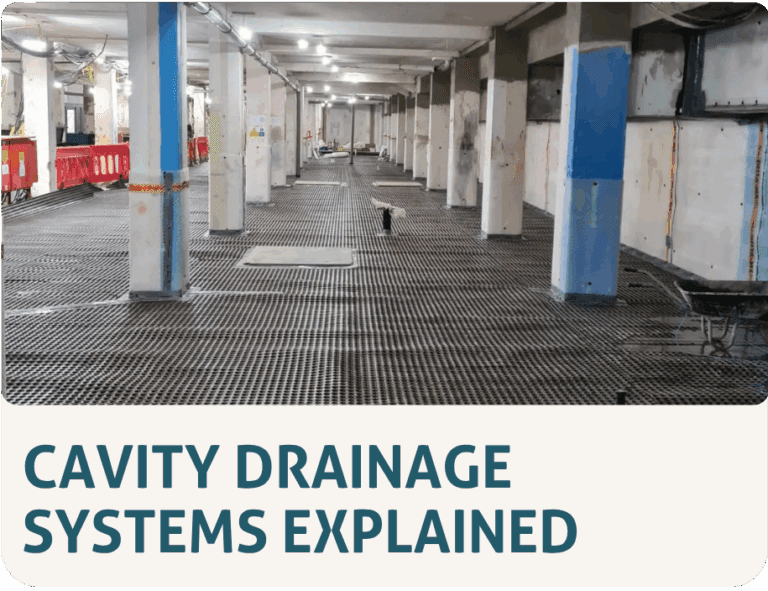
Type C (Drained Protection): Incorporates an internal cavity drain membrane system that collects and safely channels water away via a sump pump or gravity drain.
On higher-risk sites, we’ll often specify dual waterproofing systems rather than relying on one method to perform perfectly for the life of the building. We took this approach on a recent basement remediation at Willen House in Islington, where we combined Type C cavity drainage with a crystallising waterproofing slurry. With the addition of mechanical ventilation it brought the space up to a Grade 3 environment. Getting the combination right depends on a number of factors such as ground conditions and the water table, and how the structure itself is built, so it isn’t a decision we make from a standard template.
Why early involvement matters more than workmanship
In our experience, most system failures don’t come from poor installation. Instead, they come from a waterproofing strategy that has been added on after the structure’s design is already fixed. By this point, there’s little room to deal with ground conditions properly, or to detail junctions, penetrations and construction joints where many failures actually start.
The BS 8102:2022 standard identifies a “waterproofing design specialist” as a distinct role in conjunction with the Principal Contractor, architect and structural engineer. When we’re brought in at design stage rather than at tender, we can agree the grade and system against a proper site investigation, not an assumption. That’s why we stay involved from the first conversation through to completion on every project. If you’re at the design stage now, it’s worth speaking to our team before the specification is fixed.
What we’d want to see in a compliant specification
A compliant specification should state the performance grade required, the waterproofing type or combination chosen and why, and how the design handles such details as junctions and penetrations, since that’s usually where things can go wrong. It should also point to a track record on comparable structures, not just a product data sheet. We cover this in more detail across our services pages on www.gunite-waterproofing.co.uk.
Common Questions We’re Asked
Grade 2 rules out seepage or dampness and so condensation may occur and may therefore need managing.
Grade 3 needs to be completely dry with no water ingress. It’s what we specify for offices, habitable spaces and archives thus requiring the addition of mechanical ventilation / heating / dehumidification.
No. We only recommend combining systems where ground conditions or the consequences of a failure justify the extra protection. It comes down to a proper risk assessment, not a default
A waterproofing design specialist, working alongside the Principal Contractor, architect and structural engineer.
Yes, it applies to any below-ground or podium structure where water ingress is a risk, including podium decks sitting over occupied spaces.
If you’re planning a basement or podium waterproofing project and need a BS 8102:2022 compliant design, visit our waterproofing services London page to see our full range of services. Alternatively, contact us directly for advice on the correct waterproofing design for your structure.